The Rehearsal the Object of Art Is to Give Life a Shape
Acquire
Motion and Rhythm
Motion
Movement is the path the viewer's heart takes through the work of art, often to focal areas. Such movement can exist directed along lines, edges, shape, and color within the work of art. Artists apply movement to direct the viewer's heart through a piece of work of art.
There are three types of movement in art:
- concrete movement,
- juxtaposition, and
- moving the viewer's eye.
Physical Motion
Physical movement is the first blazon of movement found in an artwork. It is the obvious, physical movement. This is the feeling of activity found in a piece of work of art. This tin can be conveyed by drawing or painting lines coming from the object that is moving. It can exist bodily in a three dimensional artwork such as a mobile A mobile is a type of kinetic sculpture. Information technology consists of a number of rods from which weighted objects or other rods hang. The objects rest on the rods. The rods and objects hang from a string or wire. .
View Giacomo Balla's Dynamism of a Dog on a Leash (1912) to encounter an case of concrete movement in a work of art.
Juxtaposition
Juxtaposition is the second type of move. In juxtaposition, the artist portrays the subject in somewhat of a "freeze frame." This blazon of movement can show the subject in the air, or at an bending.
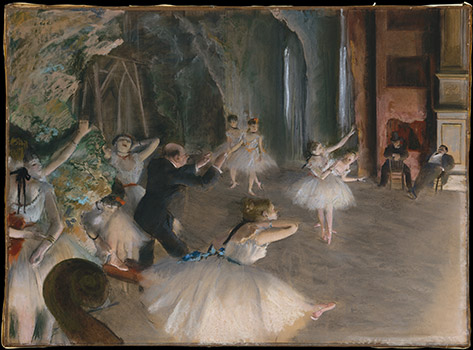
Edgar Degas, The Rehearsal Onstage, 1874, pastel over castor-and-ink drawing. See a larger version of The Rehearsal Onstage hither. Image is in the public domain.
This is an instance of juxtaposition and concrete movement in a work of art.
Moving the Viewer's Heart
Moving the viewer' s center is the 3rd type of movement. It deals with the way the viewer'due south centre moves through the piece of work of art. Movement is dictated by the way the objects are placed on the picture plane or past the way the artist uses the elements of art throughout the artwork.
Hokusai's Under the Wave off Kanagawa is an example of how an creative person tin can motility the viewer'south centre.
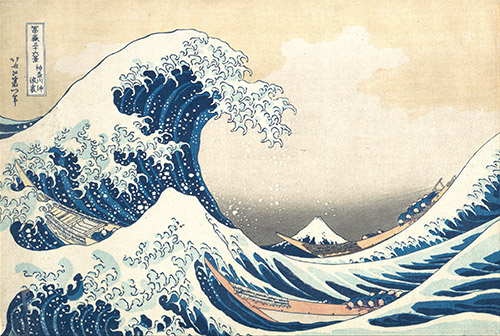
Katsushika Hokusai, Under the Wave off Kanagawa or The Bang-up Wave, 1830-1832, woodblock print, ink on paper. Come across a larger version of Nether the Moving ridge off Kanagawa here. Paradigm is in the public domain.
Rhythm
Rhythm is created when ane or more elements of design are used repeatedly to create a feeling of organized movement. Rhythm creates a mood similar music or dancing. To continue rhythm heady and active, variety is essential.
Rhythm tin be random, regular, alternating, flowing, or progressive.
- Random Rhythm: Elements are repeated with no regularity and therefore create a random rhythm.
- Regular Rhythm: Regular rhythm is created when a series of elements (often identical or like) are placed at regular intervals in an artwork. If an artist isn't conscientious, this blazon of rhythm can be monotonous or boring.
- Alternating Rhythm: Alternate rhythm is when ii or more motifs are alternated. It is like to regular rhythm but, because more than things are repeated, it adds more variety to an artwork.
- Flowing Rhythm: Flowing rhythm is created by angle and curving different elements and intervals in an artwork.
- Progressive Rhythm: In progressive rhythm, each time an chemical element or motif repeats itself, it changes a little and transforms gradually. It changes from ane matter to another.
Artists will utilise varying types of rhythm within an individual piece of work of art. Rhythm, move, residuum, and proportion, as well as accent and diversity, are ever used in a work of art to create unity.
Look at some examples of different types of rhythm below.
Edvard Munch's The Scream (1893) is an example of regular and flowing pattern rhythm.
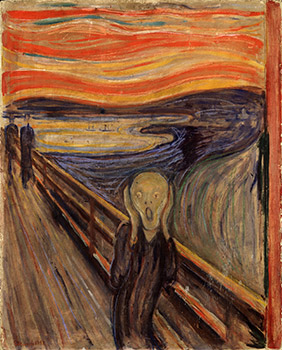
Edvard Munch, The Scream, 1893, oil and crayon on cardboard. Run into a larger paradigm of The Scream here. Image is in the public domain.
Sandy Skoglund's photograph A Breeze at Work (1987) is an instance of alternating rhythm.
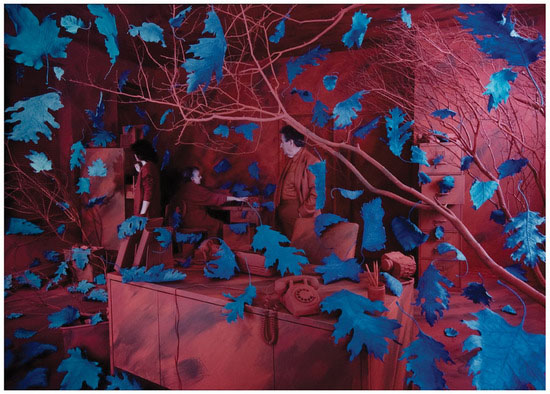
"Sandy Skoglund – Breeze at Piece of work (1987)" by cea+ is licensed under CC BY 2.0.
Open up Georges Braque's Candlestick and Playing Cards on a Table (1910) to see an example of progressive rhythm.
Repetition and Blueprint
To create rhythm in art, artists also use repetition and pattern.
Repetition is when an object, shape, form, colour, or design is repeated over and over once more to create a rhythm. It helps unify an artwork.
Gustav Klimt'southward The Tree of Life, below, is an example of repetition in a work of art.
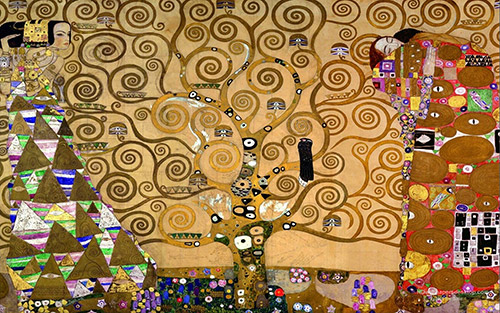
Gustav Klimt, The Tree of Life, 1909, oil on sheet. See a larger version of The Tree of Life here. Image is in the public domain.
Pattern is when a combination of elements or shapes are repeated in a predictable, recurring arrangement in a piece of work of art. Artists use pattern to symbolically correspond many things such equally people, beliefs, nature, history, and tradition in their artwork.
Wait at the dissimilar patterns on traditional Ghanaian kente cloth.

Source: https://accessdl.state.al.us/AventaCourses/access_courses/arts_survey_ua_v17/01_unit/01-07/01-07_learn_alt.htm
0 Response to "The Rehearsal the Object of Art Is to Give Life a Shape"
Post a Comment